September 14, 2025 will be marked in SEO history as the day that forever changed how web positioning tools access Google’s data. Without prior notice, without official announcement, and without giving time for preparation, Google silently eliminated the &num=100 parameter, a functionality that had been the backbone of the SEO industry for more than a decade.
The magnitude of the impact was immediate and brutal. Tools like SEMrush, Ahrefs, SISTRIX and dozens of other platforms saw their systems fail simultaneously. Operational costs multiplied by 10 overnight. Google Search Console data underwent dramatic changes that left thousands of SEOs wondering if they had been penalized by Google.
But the most shocking thing of all wasn’t the technical change itself, but what it revealed: the fragility of a multi-billion dollar industry built on the whims of a single company. This article unravels all the details of what is already known as “the great September change” and its implications for the future of SEO.
What was the num=100 parameter and why was it so important?
To understand the magnitude of this change, we must first understand what exactly the &num=100 parameter was and why it had become so fundamental to the SEO industry.
The &num=100 parameter was, in essence, a simple but powerful “trick.” By adding this text string to the end of any Google search URL, users could see 100 organic results on a single page, instead of the standard 10 results that Google shows by default.
Practical example:
- Normal URL: google.com/search?q=digital+marketing
- With num=100: google.com/search?q=digital+marketing&num=100
This functionality wasn’t originally designed for SEO tools, but it became the fundamental foundation upon which the entire rank tracking industry was built. Tools could make a single HTTP request to Google and get complete information about the top 100 positions for any keyword.
The importance was mathematical and economic:
- 1 request = 100 results (previous method)
- 10 requests = 100 results (current method)
This difference isn’t just technical; it represents a 1000% increase in necessary resources, processing time, and operational costs.
For SEO tools, this meant being able to offer complete competitive analysis, keyword tracking in “striking distance” (positions 11-20), and a holistic view of the competitive landscape that simply wasn’t viable without this functionality.
The first symptoms: tools failing without explanation
The first problem reports began to emerge between September 10 and 12, 2025, initially sporadically and confusingly. SEO tool users began reporting strange anomalies:
Initial symptoms reported:
- Rank trackers showing “position not found” errors
- Random captchas appearing in automated tools
- Incomplete or missing ranking data
- Tools reporting massive ranking drops
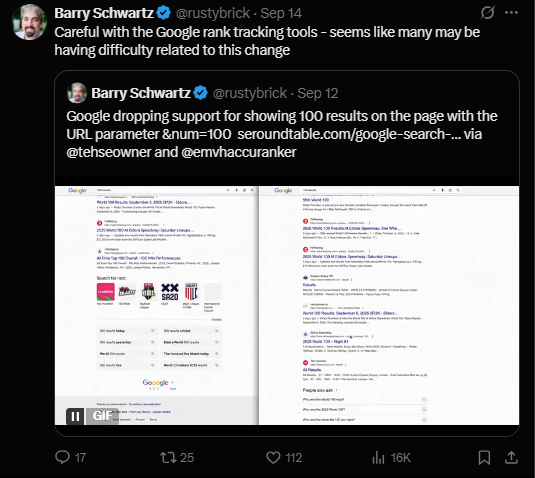
Barry Schwartz from Search Engine Roundtable was one of the first to alert about the problem, warning on Twitter: “Careful with the Google rank tracking tools – seems like many may be having difficulty related to this change.”
What initially seemed like a temporary technical problem was revealed to be something much more systematic. The parameter worked intermittently, suggesting that Google was performing a gradual rollout or experimenting with the restriction.
SEO tool developers found themselves in a Kafkaesque situation: their systems worked perfectly from a technical standpoint, but Google had silently changed the rules of the game without warning.
Timeline of symptoms:
- September 10: First reports of erratic behavior
- September 12: Significant increase in rank tracking errors
- September 14: Official confirmation of parameter elimination
The real cost of change: multiplying expenses by 10
The economic impact of eliminating the &num=100 parameter cannot be underestimated. It represents one of the most brutal and sudden cost increases the SEO industry has experienced.
The math is relentless:
| Aspect | Before the change | After the change | Impact |
|---|---|---|---|
| HTTP requests needed | 1 HTTP request | 10 separate HTTP requests | 10x more requests |
| Server and bandwidth costs | Minimum | 10x higher | 1000% increase |
| Processing time | Seconds | 10x higher (minutes) | 1000% increase |
| Rate limiting risk | Low | Exponentially higher | Critical risk |
| Technical complexity | Simple | Complex (pagination) | Reengineering necessary |
| Error probability | Low | High (multiple failure points) | Reduced reliability |
How the main SEO tools responded to the change
The response of the main SEO tools to the change has been as revealing as the change itself. Each company has adopted a different strategy, reflecting their priorities, resources, and business philosophy.
SISTRIX: “we will adapt our crawling to continue with 100 positions”
SISTRIX was one of the first tools to issue an official transparent statement about the change’s impact. Their response demonstrates a strategic approach oriented toward client value.
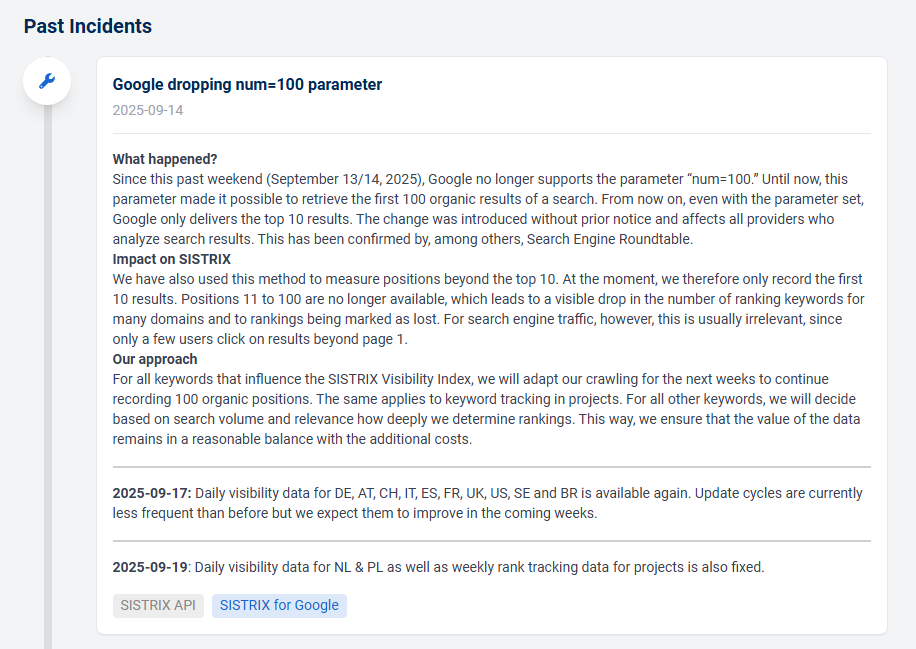
Official SISTRIX statement: “Since last weekend (September 13/14, 2025), Google no longer supports the ‘num=100’ parameter. Until now, this parameter made it possible to retrieve the first 100 organic results of a search. From now on, even with the parameter configured, Google only delivers the top 10 results.”
SISTRIX’s adaptation strategy:
For critical keywords: SISTRIX has decided to absorb the cost increase and continue tracking 100 positions for all keywords that influence their Visibility Index. This demonstrates a commitment to the quality of their main metrics.
For secondary keywords: They will implement a prioritization system based on search volume and relevance, representing a smarter and more efficient approach to resource allocation.
Current service status: Daily visibility data is available again for all major countries (DE, AT, CH, IT, ES, FR, UK, US, SE, BR), although with less frequent update cycles than usual.
This response positions SISTRIX as a tool that prioritizes service continuity and customer satisfaction over short-term margin preservation.
Ahrefs: “we can only track first page results”
Ahrefs adopted a more conservative and transparent approach, openly acknowledging the limitations the change has imposed on them.
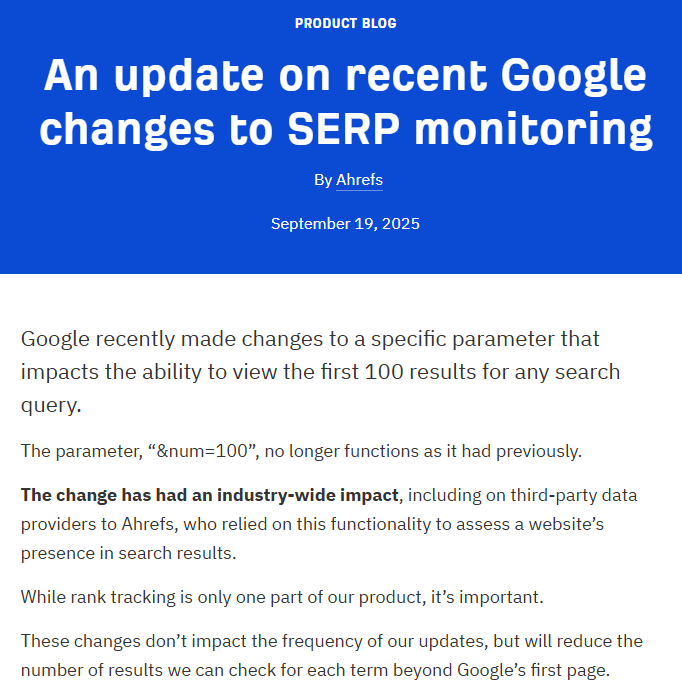
Official Ahrefs statement: “Google recently made changes to a specific parameter that impacts the ability to view the first 100 results for any search query. The parameter, ‘&num=100’, no longer functions as it had previously.”
Current limitations:
- Tracking limited to positions 1-10: Ahrefs confirmed they currently can only reliably track first page results
- Update frequency maintained: The changes don’t affect the frequency of their updates, but do affect data depth
- Quality focus: They prefer to offer accurate first page data rather than uncertain data from deeper positions
Tim Soulo’s question: Ahrefs’ CMO, Tim Soulo, posed a strategic question on Twitter asking users about the real value of tracking beyond position 20. This query suggests Ahrefs is strategically considering how far tracking is worthwhile given the new costs.
Commitment to adaptation: “Our aim is always to provide the most accurate and actionable data possible, and we fully understand this data is something our customers rely on. We’re continuing to monitor the situation and are reviewing ways to adapt to this new environment while minimizing disruption to your workflows.”
SEMrush: “industry problem with implemented solutions”
SEMrush adopted the most assertive response oriented toward business continuity, emphasizing their preparation and adaptation capacity.
Official SEMrush statement: “This is an industry-wide issue that impacts all rank tracking tools, but the good news is that we’ve already rolled out workarounds to minimize disruption and keep core functionality intact.”
Key message to clients: “For SEMrush customers, nothing changes where it matters most: Top 10 & Top 20 results remain fully intact. These ranges power Visibility, Share of Voice, and most actionable insights.”
Scale advantages: SEMrush emphasized that their massive infrastructure (processing billions of keywords monthly) allows them to better absorb this type of change. This is a clear competitive advantage over smaller tools.
Adaptation philosophy: “Google has always experimented with the way results are shown, and it will continue to do so. At SEMrush, scale is built into our DNA and we’re designed to handle shifts like this seamlessly.”
Technical problems reported: Despite the optimistic official response, users reported that SEMrush Sensor (their SERP volatility tracking tool) experienced interruptions and position tracking errors around September 10.
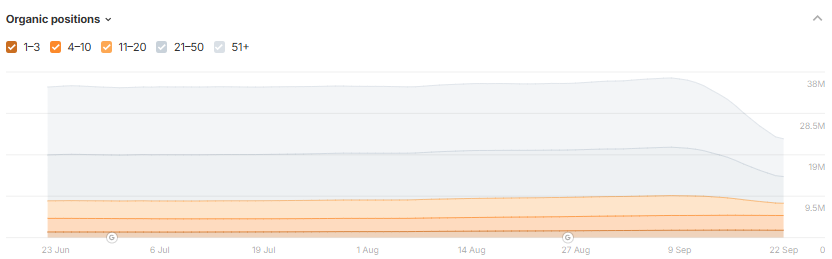
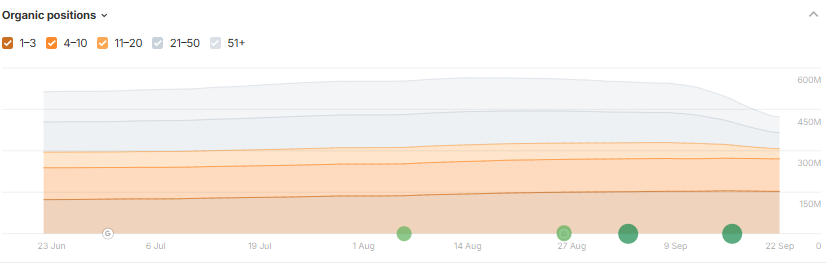
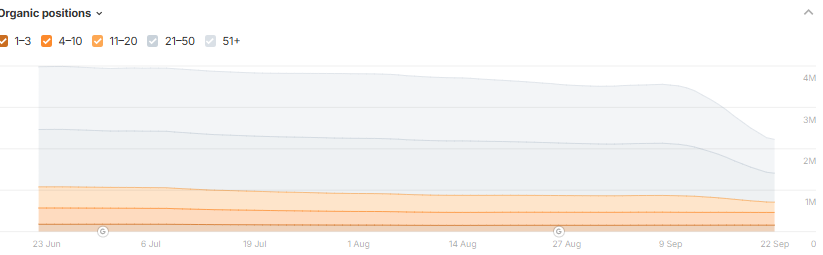
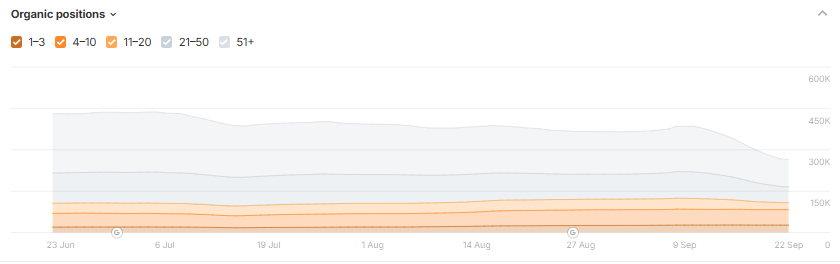
Even the biggest ones suffer the effects
Since the primarily affected are tracking tools, we can see that no one is exempt from seeing the effects on tools, even the world’s largest websites.

Even the biggest ones suffer the effects
Since the primarily affected are tracking tools, we can see that no one is exempt from seeing the effects on tools, even the world’s largest websites.
BBC News
Wikipedia
Xataka
Real Madrid
What now?
Once again this question must be running through your head – as SEOs we can’t have a peaceful month.
- So our answer is once again stay calm, don’t panic, since we have no control over the situation.
- Keep monitoring that data, now it’s much more real than before (as John Mueller has let us know “the real impressions were the friends we made along the way”).
- And as always, keep an eye on the evolution of impressions and how the whole situation is evolving, but you should pay more attention to the traffic that’s reaching you and especially to your website’s conversions.